What is EBUS-TBNA?
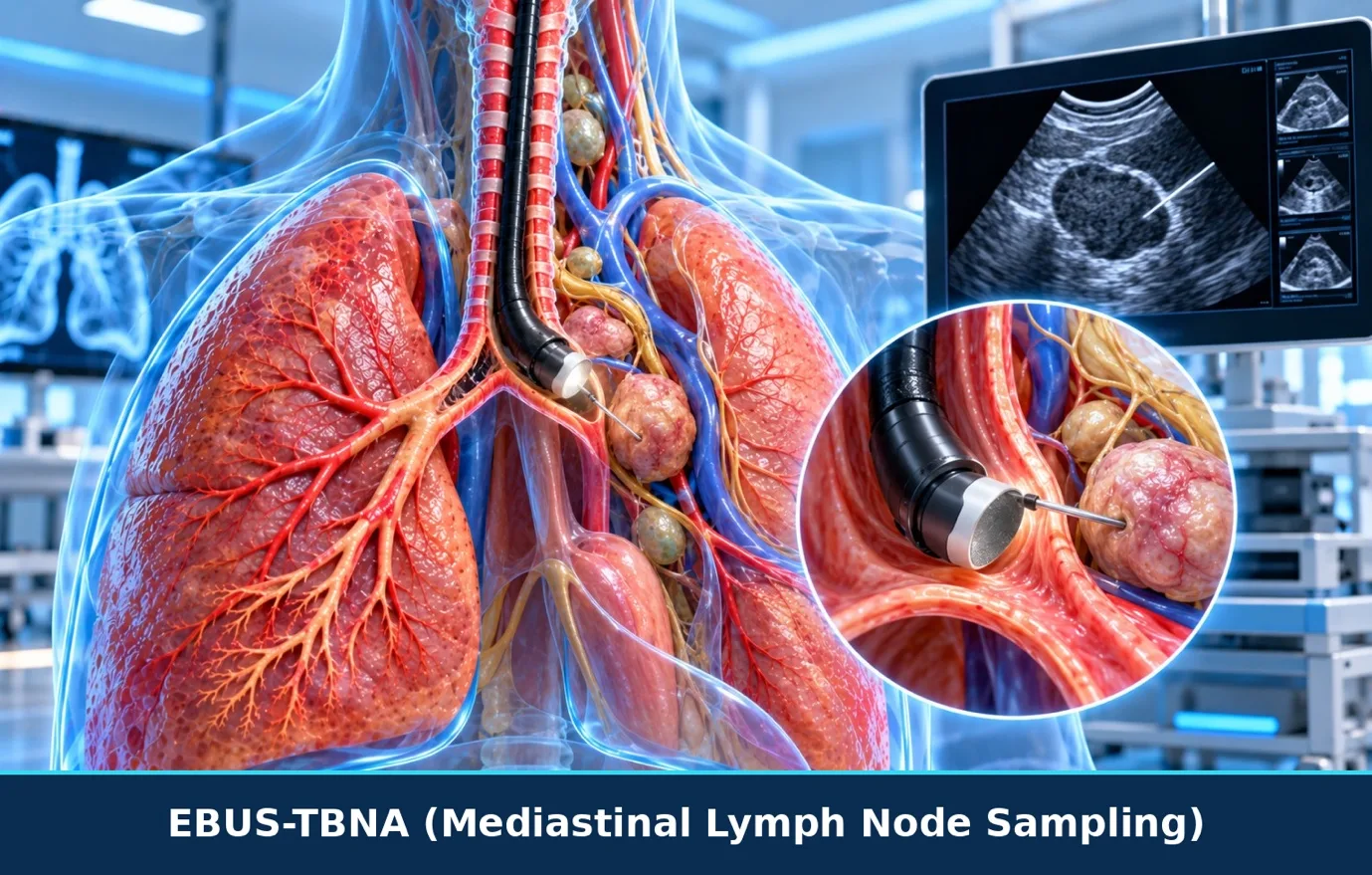
Endobronchial Ultrasound-guided Transbronchial Needle Aspiration (EBUS-TBNA) uses a special bronchoscope with an ultrasound probe at its tip. It allows the pulmonologist to see lymph nodes and masses located outside the airway walls, in the mediastinum (the centre of the chest), and sample them with a fine needle under real-time ultrasound guidance — without surgical incisions.
Why it is done
- Diagnosis and staging of lung cancer
- Enlarged mediastinal lymph nodes of unknown cause
- Suspected tuberculosis of the lymph nodes
- Suspected sarcoidosis
- Masses adjacent to the trachea or main bronchi
Before the procedure
- Fasting for about 6 hours before the procedure (you will be given exact instructions)
- Inform the team about blood thinners, diabetes medicines and allergies — some medicines may need to be paused
- Blood tests and recent imaging (CT scan) are usually reviewed beforehand
- Bring a family member or friend to accompany you home
During the procedure
- Performed under moderate sedation or general anaesthesia
- The EBUS bronchoscope is passed through the mouth
- Ultrasound identifies lymph nodes and blood vessels
- A fine needle obtains samples under real-time ultrasound vision
- Typically takes 30–60 minutes
After the procedure
- You will be observed for a short period until the sedation wears off
- Avoid eating or drinking for about 1–2 hours, until the throat numbness settles
- A mild sore throat, cough or slight blood-streaked sputum may occur briefly
- Do not drive or operate machinery for the rest of the day after sedation
- Biopsy results usually take a few days; your follow-up will be scheduled
Safety & risks
Preparation instructions may differ for individual patients — please follow the specific advice given at your consultation.
Frequently asked questions
A regular bronchoscope only sees inside the airways. EBUS adds ultrasound, allowing the doctor to see and sample structures outside the airway wall, such as lymph nodes.
In many patients EBUS-TBNA provides the necessary diagnosis and staging information without surgery. In some cases, further procedures may still be required.